2011年9月16日金曜日

Mourning the dead ( Adashino nenbutsu-dera)


People in the old days believed the paradise in Pureland was located in the west. We can find the fact in Byodoin temple in Uji because you will see the phoenix hall to the west when you see it across from the front pond. The west is the direction where the sun sets.
Adashino Nenbutsu dera( temple) is in the west of Kyoto, the end of Arashiyama area. In its name of Adashino, a kanji letter meaning "alchemize" is used. That is the place where "Life" alchemizes into "Death" and then the dead soul is reincarnated and has a new life. In the old time, people left the dead body there. I don't know why it was there. But I believe that is why it is the west and that they hoped to let the souls go to the pureland from the nearest place. ( This is just an interpretation of mine..)


A great monk, Kukai, buried the bodies and the remains there, held a service for the departed souls and prayed for them. People made and brought small stone statues and stone towers. Those in Adashino Nenbutsu dera are the ones for the dead who departed to another world in those days.
When you visit there, you will feel something solemn and specifically mysterious.
On August 22nd night, the temple holds an event for prayers. People come there and light candles and pray for the dead.

There is another stone Jizou. This is for unborn babies. When I visited there, I lit a candle and prayed for them.

This time, I visited this temple with a woman from Rumania. We talked a lot about this temple and how death is interpreted in Buddhism. It was a very hot day in summer. But walking from Arashiyama river side to this temple through the countryside gave us something valuable in our minds.
If you are interested in an insight of religion and local culture, visiting here will let you feel something unexpected.


Tour date ; July 22nd
Tour : Golden pavillion, Adashino nenbutu dera, Bamboo forrest, Sanjusangendo hall
Tourist ; a woman from Rumania

Adashino nenbutsu dera 9AM -4PM ( -3:30PM in winter)
Admission 500 yen
Access 30min walk from Arashiyama Randen station
40min ride Kyoto bus ( not city bus ) from JR Kyoto station
(the nearest bus stop - Toriimoto )

2011年8月29日月曜日

Comparison between Golden and Silver pavillion


All visitors to Kyoto don't miss seeing the Golden Pavillion, do they? In fact, it is one of the Must-sees of Japan. When you step into the precinct and the shining golden pavillion comes into sight, you will probably say something exclamatory. In addition, the so-called mirror pond in front of it makes this pavillion more impressive by reflecting the pavillion on its water surface as if it were a mirror. Yes, it is surely the one sight you can't skip on your tour.

The time when the Golden pavillion was founded was when Kitayama culture was at its best. Kitayama culture is a fusion of aristractic culture and samurai culture. The temple represents Kitayama culture. The pavillion was made with those characteristics on each floor; the first floor of the pavillion is in so-called Shinden-zukuri, or Aristocratic style. The second floor is in so-called Buke-zukuri, or Samurai style. The third has a religious atmosphere of Zen.

On the other side of the city, you can also enjoy the other pavillion, the Silver pavillion. Whether the pavillion was coated with silver at the beginning or not is unknown, or has many views.
Putting that aside, the Silver pavillion has a different atmosphere. The founder of this temple, the grandson of the founder of Golden pavillion, was a person of taste or a person of culture. He founded the pavillion based on his grandfather's work. However, he loved an authentic beauty known as "Wabi" and "Sabi" originated in Zen spirit, the main idea of which is simplicity. Please touch the beauty coming from an inner part of your heart when you are in Kyoto.
When you get into the Ginkakuji, you will first see the mound of white sand called Kogetsudai, The literal meaning is the place toward the moon. The effect of this white sand is to make the surroundings brighter by reflecting the moon light. This neatly shaped sand mound will surely impress you
There is one more thing I want to mention about here. That is moss!
The founder, the 8th shogun of Ashikaga shogunate, liked Saihoji temple which is known as a moss temple. One half of the garden was covered with this green moss. I recommend you to visit here in May or Jun while its green is vivid to your eyes. This temple doesn't show you a gorgeous aspect but I am sure you will understand the beauty of our culture while visiting here.


I visited both temples with an Australian couple. After visiting both temples, I asked which they preferred. They said that they understood each temple's authentic beauty. Their answer was that the two had their own individual beauty and that both were nice in their own special way.
That is probably the right answer!


Date : July 20th


Tourists : a couple from Australia


Tour : Ryoanji rock garden, Kinkakuji, Ginkakuji, Phylosophy path, Nanzenji temple, Heian shrine ( by themselves)

2011年7月6日水曜日

The temple with hydrangeas in the garden

Hydrangeas in the rain are so beautiful, aren't they? From the middle of June to early July is the high season for hydrangeas in Japan. After the rain, the flowers are washed by the rain and show more vivid colored faces to us. There are some temples known by the garden with hydrangeas. Mimurodo temple is one of them. It is located near the world heritage site, Byodoin temple known as a phoenix hall. The temple is on the hill and you can take a shuttle bus from JR Uji station to the temple during the hydrangea season.
Before visiting Hydrangea garden, why don't you walk up to the main hall? In front of the hall, you will see a lot of lotuses. As you see, Buddha images usually sit on a Lotus Flower. So the view of a lot of lotuses makes us, Japanese, feel something calm.


Just before the hall, you will see a stone cow image. This gives us a good luck for a victory. If you participate in a competition, a race, a contest or lotteries(?). Please touch a ball in its mouth and you will gain a good luck for it. Though I don't especially have a chance to take part in something, I touched and wished a good luck. If the god has a good memory, I will win in a race or competition in the future. Till then, I have to keep this good luck.


Let's go to the Hydorangea garden. Here you can enjoy 1000 hydorangeas. Before visiting here, I just know only the typical kind of these flowers. When I saw them one by one, I found them so impressive and beautiful. Actually I saw the kind I hadn't seen before. I really enjoyed this beautiful scenary.

After I came home, I came to know that there is a heart-shaped hydrangea flower in the temple.
When I visit there again ( maybe next year?), I will try to find it.

Mimurodo temple
The nearest station : Mimurodo station ( Keihan Uji line)
Shuttle bus : JR Uji station to the temple ( during the high season only)
Time ; 8:30AM - 4:30 PM
Admission : 500 yen


2011年6月2日木曜日

Shopping in Japan means....

Among the cancellations, one group decided to make a tour in March just after the quake. One of them said that, though it might be a tiny contribution, shopping in Japan would help the economy after the disaster.

According to their words, they arrived in Fukuoka, western Japan, and headed for Kansai region. Ririko and I were their guide on each day during their stay in Kyoto. They are much interested in fabrics, so on the first day, Ririko took them to Nishijin texile center. There were few people because of the decrease in the number of the tourists to Japan. Seeing from the other point of view, they fully enjoyed the texile center without being annoyed by so many visitors, and not to mention they bought a lot of goods made of Japanese fabric.

On the second day, I was a guide and showed them around in Higashiyama area. I suggested visiting Nishiki market to have them see our food culture. However they did like to see other kinds of fabrics in the shops along the path from Ginakuji temple, as well as Sanneizaka and Nineizaka.

One of the members of the group found what is called Hachimaki. On one "hachimaki" said " Hissho!" ( 必勝 ) The direct translation is " must win " or " a strong will to win" . According to the translation on the paper board in the shop said "Sure victory". It sounded a little strange to me, but he really liked these words and bought one. In addition, he bought another one for his friend.


He repeated again and again "Sure Victory" "Sure Victory" He seemed so happy to have one.
So I asked a silly question to him. "If you have one, you will surely win, right? But in the case you have to fight against the friend you give the other 'Sure Victory' to, who will win???  You have to hold two hachimakis to make sure the victory? " That was funny to us.

We enjoyed our tour so much.

Date : March 23rd and 24th
Tourists ; a family from Malaysia
Tour : 1st day
Ishibeikoji, Entokuin ( tea ceremony ), Mimiu( Udon lunch)
Nishijin texile center
2nd day
Kiyomizu temple, Sanneizaka Nineizaka Kamanza
( tempura lunch) Yasaka pagoda Ginkakuji temple

In kamanza, they serve yuba-donburi. It's one of the specialities in Kyoto. It is very simple donburi but worth trying if you like Japanese soup and tofu.

2011年5月14日土曜日

Kindness of a Japanese woman

In March after the earthquake, I have worked as a guide twice. One of them was just after the quake. Of course, they had alreadly come to Japan when the disaster hit.

I got an e-mail from them while they were staying in Tokyo. Until I met them in Kyoto, I had been wondering how they were spending the time before coming to Kyoto, and whether they could come to Kyoto or not.
Finally, I met them on 14th morning. I was relieved to know they were safe, and then asked how they managed to get along.
At the time of the quake, they were in Kamakura enjoying sightseeing. Just after the quake, JR in this area was halted, which means they had no way to come back to Tokyo and had no one they knew there.
However, a Japanese woman spoke to them, and she opened her private house to let them stay for a night. When they got to her house, they found some other foreign tourists being there. Of course, they all were not aquainted with her at all, and that was the first time to meet each other.
In addition, her neighbor also offered what is called Onigiri ,or rice balls, to them. After JR recovered its service, they were able to go back to Tokyo.
I was very happy to hear this story, and was proud of being a Japanese. She didn't forget to be kind to others at the time of emergency. That is a wonderful thing, isn't it?
They changed their tour plan and decided to stay in Kyoto for the rest of the days in Japan.

I showed them to Higashiyama area. Since they were forced to unexpectedly change their plan, I suggeted another tour to them on another day during their stay. They were pleased to accept my offer. Unfortunately it wasn't realized due to the recommendation to come back home by the embassy.
Anyway, we enjoyed tea ceremony, and fully enjoyed beautiful scenery in Kyoto. The life in Kansai area including Kyoto was going as usual. I did the guide as much as I could because they couldn't enjoy another city they were supposed to visit because of the unprecidented disaster. I hope they still like Kyoto and Japan. And, if I have another chance to be their guide, I do want to show them to the places not in a guidebook. That was their honeymoon, and the quake kept them from fully enjoying their tour. Thinking of it, I really feel sorry.


Date : March 14th

Tour ; Kiyomizu temple, Sanneizaka Nineizaka, Entokuin ( tea ceremony) Silver pavillion, Golden Pavillion

Tourists ; a couple from Spain

2011年4月30日土曜日

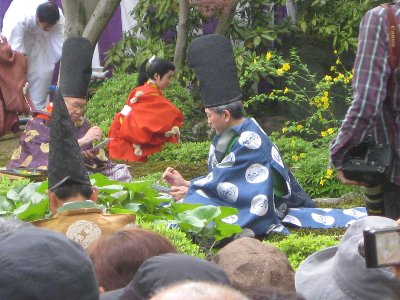
Making a poem by the side of a stream

In Heian era, how did the aristrats have fun in their life without movies, televisions or radios? What is called "Kyoku-sui-no-en" was one of the way for having fun. "Kyoku" means twisting or twisted, " sui" means water or a stream, and "en" means an event or something like a party. They sat by the side of a twisted tiny stream, making poems and sipping sake.


A glorious spring weather makes us pleasant. However, in the days of old, it also brought the epidemic of bad diseases. So the people bathed in the river and prayed for their safety. This is the origin of "Kyokusui-no-en" Later, the Emperor invited his people and the aristcrats having an event by the riverside.

At first, a dancer called Shirabyoshi demostrated her beutiful dance to the invited. And then, boys carried small floats with a small cup of sake on, and they put them on the water. The floats slowly flowed on the water. The poets saw the floats going on the stream, and piked one on the float and sipped it after making a poem and writing it on a strip of paper.

The cards written a poem were gathered and the poems were announced with specific tones by the announcers.
I fully enjoyed the scene thinking of the old days and the people enjoying this event.
This event is held in Spring and Autumn.

After the event, we walked in the garden of this shrine. One thing good is that we can see the garden for free of charge because of the event. How lucky !

2011年4月24日日曜日

Cherry blossoms in 2011


Please imagine the riverside decorated with the color of pink.
Please imagine the sky covered with the color of pink when you look up the sky.


Why don't you come and enjoy this beautiful scenery?

The high season in 2011 was between April 6th and 10th depending on the places.