2011年6月2日木曜日

Shopping in Japan means....

Among the cancellations, one group decided to make a tour in March just after the quake. One of them said that, though it might be a tiny contribution, shopping in Japan would help the economy after the disaster.

According to their words, they arrived in Fukuoka, western Japan, and headed for Kansai region. Ririko and I were their guide on each day during their stay in Kyoto. They are much interested in fabrics, so on the first day, Ririko took them to Nishijin texile center. There were few people because of the decrease in the number of the tourists to Japan. Seeing from the other point of view, they fully enjoyed the texile center without being annoyed by so many visitors, and not to mention they bought a lot of goods made of Japanese fabric.

On the second day, I was a guide and showed them around in Higashiyama area. I suggested visiting Nishiki market to have them see our food culture. However they did like to see other kinds of fabrics in the shops along the path from Ginakuji temple, as well as Sanneizaka and Nineizaka.

One of the members of the group found what is called Hachimaki. On one "hachimaki" said " Hissho!" ( 必勝 ) The direct translation is " must win " or " a strong will to win" . According to the translation on the paper board in the shop said "Sure victory". It sounded a little strange to me, but he really liked these words and bought one. In addition, he bought another one for his friend.


He repeated again and again "Sure Victory" "Sure Victory" He seemed so happy to have one.
So I asked a silly question to him. "If you have one, you will surely win, right? But in the case you have to fight against the friend you give the other 'Sure Victory' to, who will win???  You have to hold two hachimakis to make sure the victory? " That was funny to us.

We enjoyed our tour so much.

Date : March 23rd and 24th
Tourists ; a family from Malaysia
Tour : 1st day
Ishibeikoji, Entokuin ( tea ceremony ), Mimiu( Udon lunch)
Nishijin texile center
2nd day
Kiyomizu temple, Sanneizaka Nineizaka Kamanza
( tempura lunch) Yasaka pagoda Ginkakuji temple

In kamanza, they serve yuba-donburi. It's one of the specialities in Kyoto. It is very simple donburi but worth trying if you like Japanese soup and tofu.

2011年5月14日土曜日

Kindness of a Japanese woman

In March after the earthquake, I have worked as a guide twice. One of them was just after the quake. Of course, they had alreadly come to Japan when the disaster hit.

I got an e-mail from them while they were staying in Tokyo. Until I met them in Kyoto, I had been wondering how they were spending the time before coming to Kyoto, and whether they could come to Kyoto or not.
Finally, I met them on 14th morning. I was relieved to know they were safe, and then asked how they managed to get along.
At the time of the quake, they were in Kamakura enjoying sightseeing. Just after the quake, JR in this area was halted, which means they had no way to come back to Tokyo and had no one they knew there.
However, a Japanese woman spoke to them, and she opened her private house to let them stay for a night. When they got to her house, they found some other foreign tourists being there. Of course, they all were not aquainted with her at all, and that was the first time to meet each other.
In addition, her neighbor also offered what is called Onigiri ,or rice balls, to them. After JR recovered its service, they were able to go back to Tokyo.
I was very happy to hear this story, and was proud of being a Japanese. She didn't forget to be kind to others at the time of emergency. That is a wonderful thing, isn't it?
They changed their tour plan and decided to stay in Kyoto for the rest of the days in Japan.

I showed them to Higashiyama area. Since they were forced to unexpectedly change their plan, I suggeted another tour to them on another day during their stay. They were pleased to accept my offer. Unfortunately it wasn't realized due to the recommendation to come back home by the embassy.
Anyway, we enjoyed tea ceremony, and fully enjoyed beautiful scenery in Kyoto. The life in Kansai area including Kyoto was going as usual. I did the guide as much as I could because they couldn't enjoy another city they were supposed to visit because of the unprecidented disaster. I hope they still like Kyoto and Japan. And, if I have another chance to be their guide, I do want to show them to the places not in a guidebook. That was their honeymoon, and the quake kept them from fully enjoying their tour. Thinking of it, I really feel sorry.


Date : March 14th

Tour ; Kiyomizu temple, Sanneizaka Nineizaka, Entokuin ( tea ceremony) Silver pavillion, Golden Pavillion

Tourists ; a couple from Spain

2011年4月30日土曜日

Making a poem by the side of a stream

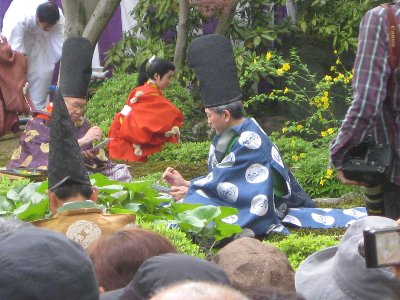
In Heian era, how did the aristrats have fun in their life without movies, televisions or radios? What is called "Kyoku-sui-no-en" was one of the way for having fun. "Kyoku" means twisting or twisted, " sui" means water or a stream, and "en" means an event or something like a party. They sat by the side of a twisted tiny stream, making poems and sipping sake.


A glorious spring weather makes us pleasant. However, in the days of old, it also brought the epidemic of bad diseases. So the people bathed in the river and prayed for their safety. This is the origin of "Kyokusui-no-en" Later, the Emperor invited his people and the aristcrats having an event by the riverside.

At first, a dancer called Shirabyoshi demostrated her beutiful dance to the invited. And then, boys carried small floats with a small cup of sake on, and they put them on the water. The floats slowly flowed on the water. The poets saw the floats going on the stream, and piked one on the float and sipped it after making a poem and writing it on a strip of paper.

The cards written a poem were gathered and the poems were announced with specific tones by the announcers.
I fully enjoyed the scene thinking of the old days and the people enjoying this event.
This event is held in Spring and Autumn.

After the event, we walked in the garden of this shrine. One thing good is that we can see the garden for free of charge because of the event. How lucky !

2011年4月24日日曜日

Cherry blossoms in 2011


Please imagine the riverside decorated with the color of pink.
Please imagine the sky covered with the color of pink when you look up the sky.


Why don't you come and enjoy this beautiful scenery?

The high season in 2011 was between April 6th and 10th depending on the places.

2011年4月7日木曜日

Monkey Park

Once I have been asked for a suggestion besides visiting temples and shrines by a mother of cheerful boys. At that time, I picked up Monkey Park in Arashiyama. They were pleased to have this itenerary. Unfortunately, we had to give up visiting there due to the weather on that day.
This year, I visited there with other tourists.

If you have enough time during your stay in Kyoto, if you want to visit anywhere else after visiting temples and shrines, and if you like animals, how about visiting Monkey Park?

I didn't know Japanese Monkeys ( I don't know whether it is the proper way to call them) were special for visitors from abroad. However, the monkeys are to be seen in Asia, aren't they?

You can see and feed wild monkeys there.
After walking up the hill for a while, you will find some monkeys playing, sitting, walking here and there. If you want, you can get their food in the hut, and feed them from the inside of the hut. Inside?? Yes, from the inside! From the outside, the monkeys get food from you. At first it seems a reverse way, but it is actually safer. So feeding them outside is, of course, prohibited.

Anyway, feeding is a lot of fun.
Why don't you visit this Park ? Oh, one thing I have to say!! Please wear sneakers! The reason?
You can know when you get there!!


Date : March 5th
Tourists : a couple from Australia
Tour : Tenryuji temple, Bamboo forest, Togetu bridge and walking riverside, Monkey park, Ryoanji temple, Kinkakuji temple ( Golden Pavillion.

2011年2月2日水曜日

Kyoto in the snow

It rarely snows in Kyoto in spite of the cold climate. Even if it snows, the architectures and the gardens in Kyoto are seldom covered with snow. Tourists as well as the citizens have few chances to see the scene in the snow.
The day before our tour it was snowing. And that morning, it was still very cold. I expected the scene with snow. After picking them up at the hotel, we headed for Arashiyama where it is comparatively colder than in the center of the city. That was, in a sense, BINGO!

The first leg of our tour was Bamboo forest. When we got there, it was snowing. That was the first time for me to see Bamboo forest in the snow. Sometimes we saw the sunshine coming through among those tall bamboo trees. It was very impressive.


We walked along the Hozu river. The mountains were also covered with snow. The air was clean, which made the scenary so beautiful.
Then we went back to the city and visited Ninnaji temple.
The sand in the garden was white, whiter than usual. We enjoyed this garden and visited the next temple Ryoanji rock garden.


This garden was very famous for the sand and rock garden. A half of the sand garden was in the snow. It showed me a different aspect from what I always see when I visit there as a guide.
This temple obtained the paintings which it had lost a long time ago. They returned for the first time in about 100 years. Those paintings are being exhibited for a time being. I came to know this exhibition on the news, but that was the first time to directly see this artistic works.


We found something yellow flower-like in front of the paintings. One of us asked me what it was. And I didn't know and haven't seen it before. In that case, I usually make it a rule to ask soembody in the temple, and I did so. It was a kind of citrus fruits called "Bussh", which means " a hand of Buddha" They say that we can see this just in this season in the year. It really convinced me. Actually they look like hands, don't they?


I expected the snow covered the roofs of Golden pavillion. Unfortunately, we could not see the expected scenary. The front side of the architecture was toward the sun. It had a lot of sunshine in the morning, and when we were there, the snow on the roofs was no longer there. However, we did enjoy the beautiful sight!


We tried OKONOMIYAKI for lunch. ( Actually they cooked it by themselves!) And the last leg was Nishiki food market. When it comes to trying something new, ( in the case of Nishiki market, it is usually Octopus), it will be a man or a boy. This time was no exception. He was forced to try it for taking a pic.


But it was not so bad!! In fact, it is very tasty. Why don't you try it by yourselves???? One more attraction in Nishiki market is a soymilk doughnut, or soymilk softcream icecream. You should try them! They bought 23 doughnuts and my share of them were 3, or 4..probably. Needless to say, I got full!


After their stay in Kyoto, they were going to go skiing in Nagano.


Tour date ; Jan. 18th

Tourists : a group from Australia

Tour : Bamboo forest, Togetu bridge, Ninnaji temple, Ryoanji rock garden, Golden pavillion, Nishiki food market.
(pic : having doughnuts)

2011年1月16日日曜日

Worth being with a guide

This time, the hours for which I was a guide were not enough to make a one-day tour.

I couldn't stay as a guide for a long time due to my job schedule, however, they accepted my condition. So I did my best to make our tour worthier.
We met them in front of Kiyomizu temple. This is the first time to meet someone there. Usually there are so many tourists in and around Kiyomizu temple, and I thought it was very difficult to find each other. My expectation was completely betrayed. The sightseeing spots in Kyoto in winter may not be so beautiful as they are in a high season, but there is certainly the way to enjoy this old city.

They wanted to do what they can't do without a guide. The first thing we did was Tea Ceremony.I took them to ENTOKUIN temple to have a tea ceremony.
Not only in the typical tea room but in the traditional way, you can enjoy the ceremony in this temple. However, the people there cannot speak English, so Engilsh speaking guide is necessary to do this.
Entering from a window-like door after walking on the stepping stones was also interesting for them. In the room, I explained where the guest territory is and how they should sit.
In the room there is space for the guests and for the host.
At first ,WAGASHI for tea ceremony was carried. The host sat and bowed very politely and said welcoming words. She put Wagashi outside of the guest territory and the guest pulled it to thier front. Before having tea, the guest have to eat all the served Wagashi.
This temple is connected to Kodaiin, which was built for mourning Toyotomi Hideyoshi, the most powerful general in the 16th century. His symbol on the banner at the time of fight was so-called Sennari-hyotan, a gourd. The wagashi served here has a shape of a gourd.
I explained the manner of tea ceremony one by one and they followed what I said.
After that , they said that was really what they wanted to do.

Then we went to Chionin temple.


Chion in is a head temple of Jodo sect of Buddhism. There are about 20 Buddhism sects. Jodo sects was the religeon of Tokugawa family, the last shogunate which lasted about 200 years.
So we can find the family crest of Tokugawa family in this temple. This temple is a nice place for you to touch the surface of Buddhism. Most of the time, we can hear the monks chanting in the big hall. Before entering the hall, I explained to them that, in this sect, people will be salvated if they chant a buddhist sutra, like "Namiamudabutsu----namiamudabutsu---". When we entered the hall, we heard the monks chants Namiamudabutsu----namiamudabutsu- in a low voice. We felt very solemn atmosphere.


Then, we went to Shorenin temple. Till Edo period, a member of Imperial family used to become a monk of this temple. Once this temple was used as a tentative Imperial palace. In front of so-called Shishinden, the big hall, there are two trees which must be in front of the main hall of the real Imperial Palace, a cherry tree on the left and a mandarin orange tree on the right.

You can walk through the garden, and at the last part, you can strike the bell. In buddhism, it is said we have 108 worldy desires. and they will be removed when we strike the bell 108 times. This is why the bell in every temple is struck 108 times at the end of the year to welcome the coming new year.
After visiting those temples, we had OKONOMIYAKI lunch, and went to the last leg, Nishiki food market, not to mention I all explained Japanese food sold there.Blessed a fine weather, though it was a few hour tour, I had a good time and I hope they did, too.


Date : Jan. 12th
Tourist : a couple from Russia
Tour : Kiyomizu temple, Sanneizaka Nineizaka Entokuin, Ishibekoji, Chion-in, shoren-in, Okonomiyaki lunch, Nishiki food market